


Lines in Motion with Enrique Pérez-Garci
A journey through urban spaces with harmonic curves and captivating contrasts. Discover the street photography of Enrique Pérez-Garci in this article.

Meet Enrique Pérez-Garci
I first met Enrique at a local event, and his photography struck a chord with me. His street photography captures many of the elements I like in this genre: bold contrasts, minimalist compositions, and the clever use of curves and leading lines. Born and raised in Mexico City, Enrique lives now in Switzerland. The shots below reflect scenes from both countries.
Enjoy the show.
The straight line is godless and immoral
“Die gerade Linie ist gottlos und unmoralish (The straight line is godless and immoral)” Friedensreich Hundertwasser.
Streets represent scenarios where human life can perform at its best. Urban spaces tend to have architectural spots that are dominated by straight, bending, and curved lines, which often frame our daily activities in an inadvertent manner. These structures can also help us to isolate ourselves from the crowds. I aim to capture these unique moments through my photography.
To do my photography I usually walk for hours our even catch a random train or bus to another city to find areas rich in light contrasts, textures and line patterns to create my imagery version of urban life. When I discover a potential scenario, I spend some time firstly to find an interesting angle and secondly to wait (sometimes for even hours) to capture an interesting subject passing by. Large angle lenses are my first choice to give a particular twist to my compositions, and I subsequently edit the photos by using high contrast B&W and negative spaces to add a minimalist atmosphere.
… Straight or curved lines? What do you prefer?
Enrique Pérez-Garci
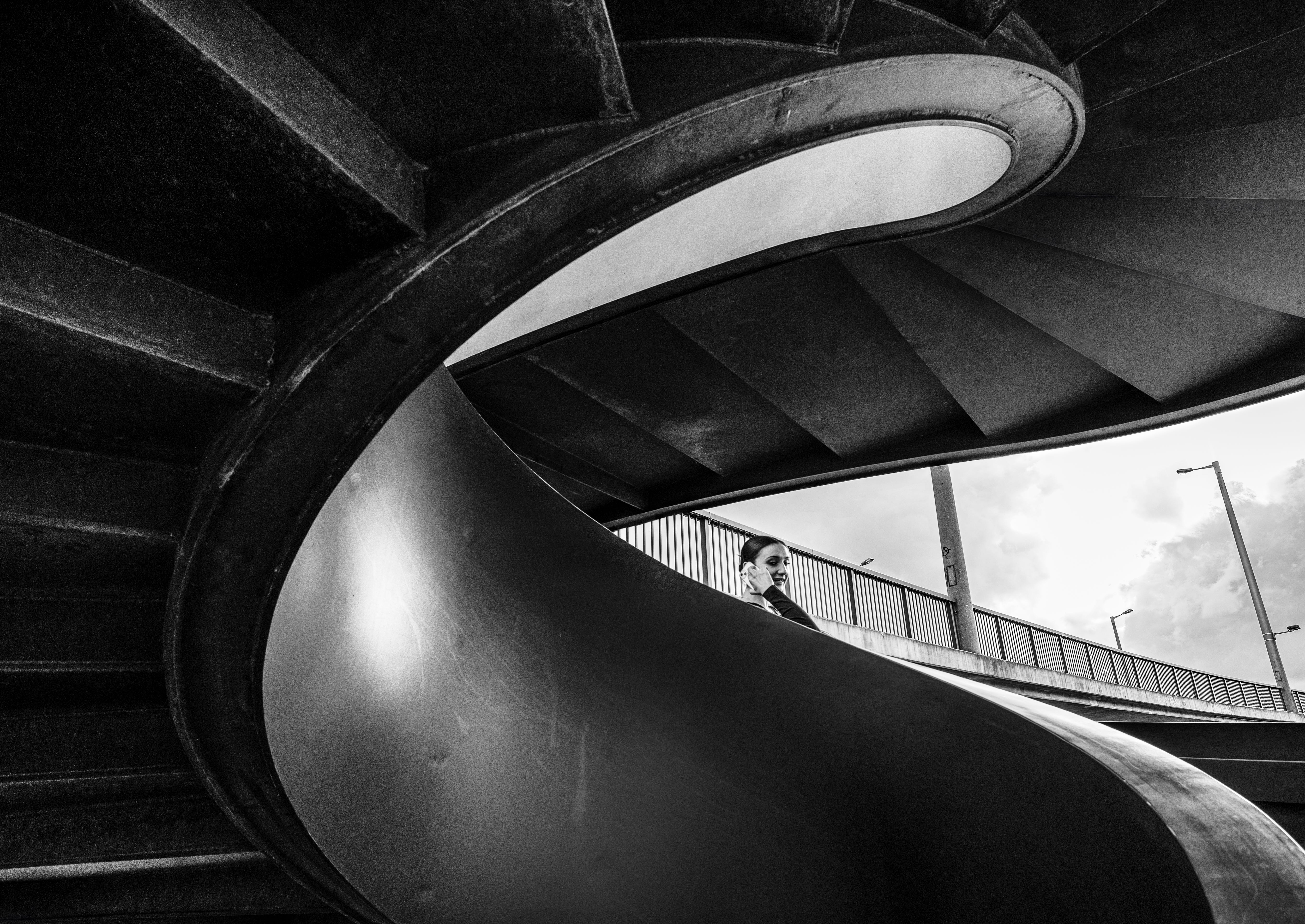
The spiral structure dominates the frame, leading the viewer's eye through its sweeping curve. It creates a sense of movement and rhythm, almost like a Möbius strip.
The curved opening provides a natural frame for the subject—a person engaged in a phone call—adding depth and visual interest. This framing directs the focus while maintaining a dynamic interaction between the subject and the environment.
The interplay between light and shadow emphasizes the textures of the metal and the softness of the human element. The lighting highlights the metallic surface, making it appear smooth yet industrial.
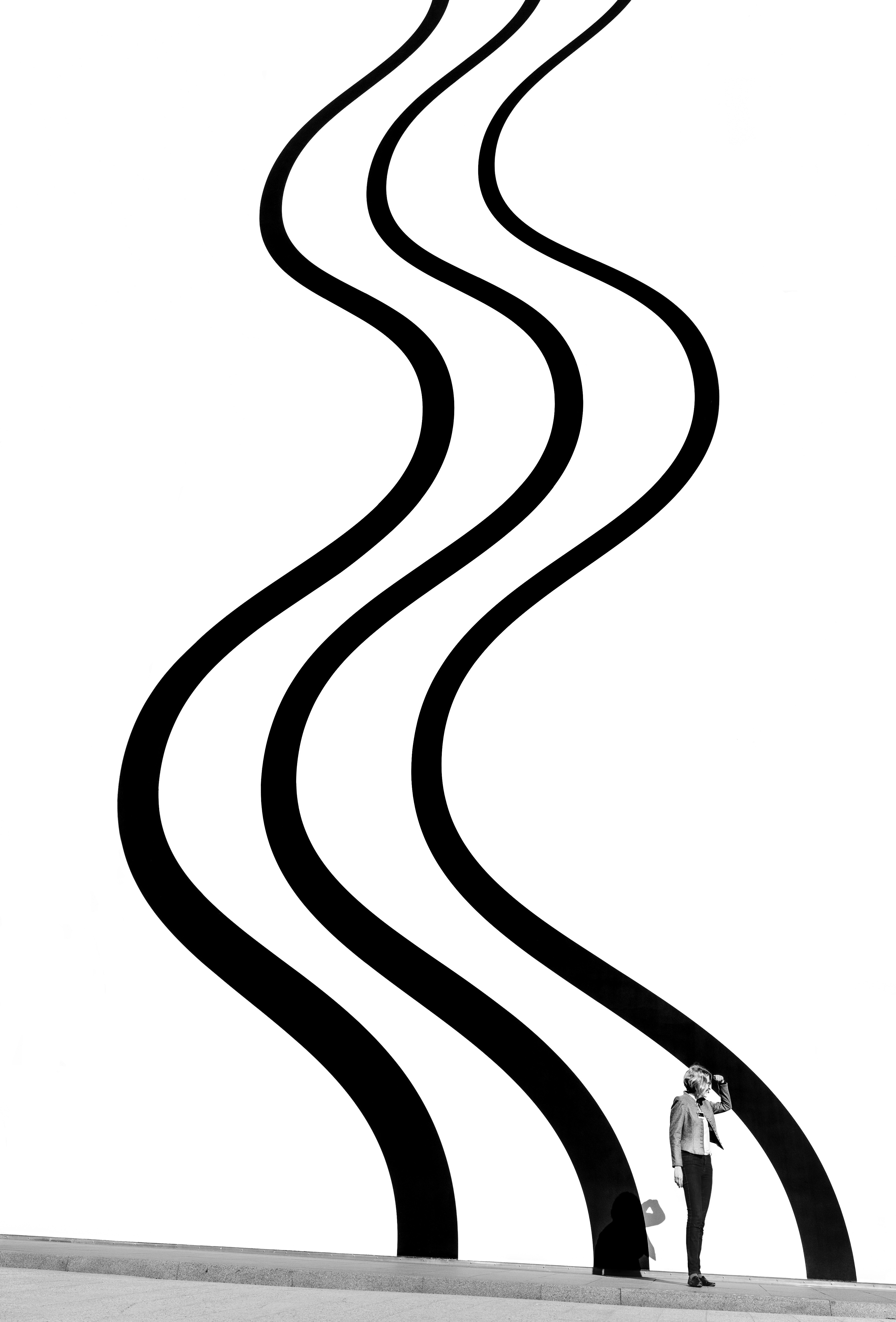
This picture is a personal interpretation of the Wall Painting “Structure of life” by the artist Claudia Compte located at the Novartis Campus in Basel Switzerland.
The black, flowing curves dominate the frame, guiding the viewer's eye upward and creating a sense of movement and rhythm. These lines are reminiscent of abstract art, suggesting a sense of continuity and flow.
The individual stands at the bottom right corner, creating a deliberate asymmetry that balances the composition. This photo contrasts the bold, flowing curves of the black lines with the thin, upright figure of the woman. Her straight, tall profile stands out against the smooth, bending lines, creating a balance between movement and stillness in the composition.
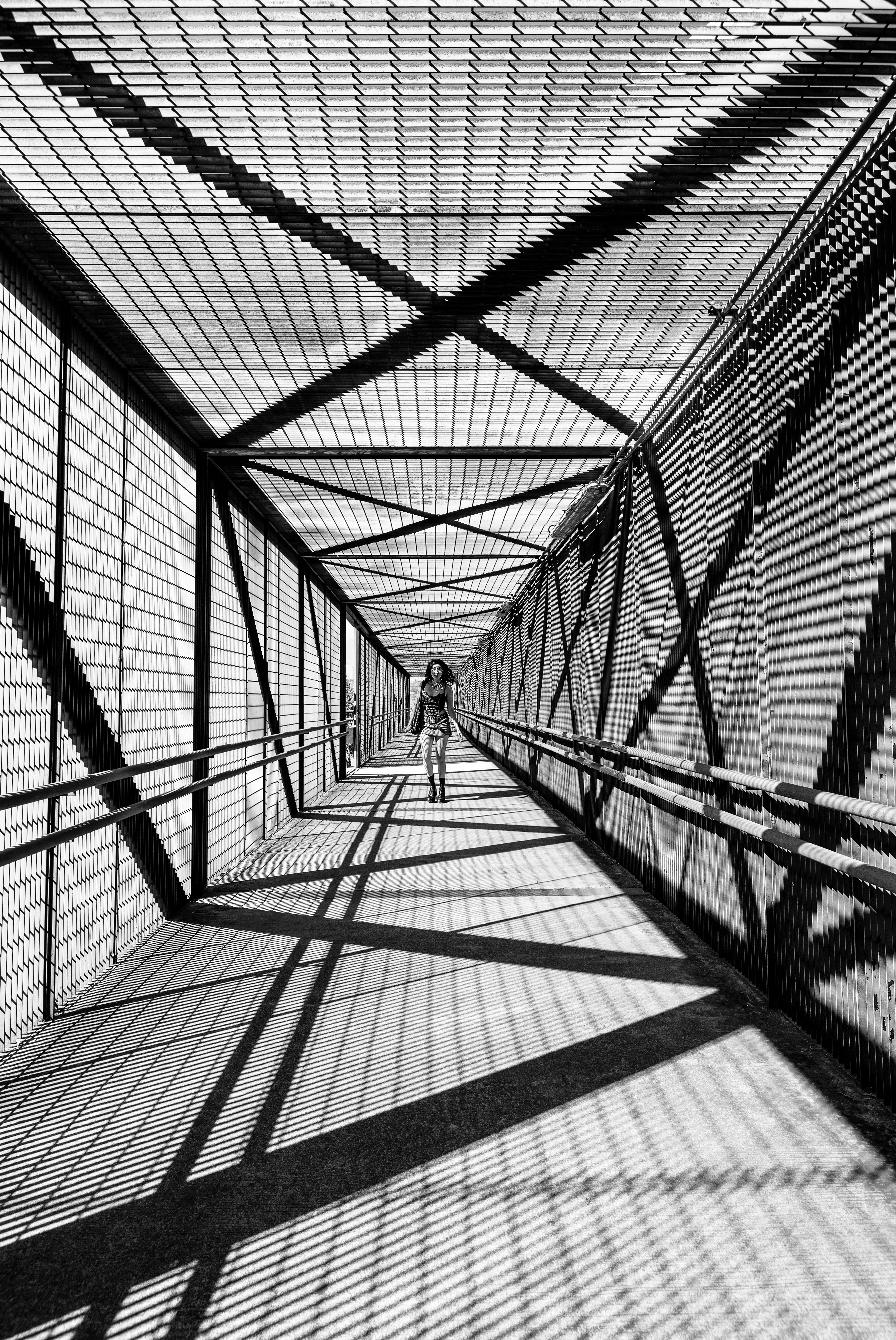
This photograph, taken in Mexico on a pedestrian bridge crossing one of the city’s largest avenues, captures an interplay of geometry, light, and shadow.
The crisscrossing metal framework and grid-like fencing create a repetitive pattern of lines and angles. The perspective converges toward the vanishing point, drawing the viewer's eye along the pathway.
The lone figure walking confidently toward the camera breaks the rigidity of the structure. Her presence adds a sense of movement and humanity to the symmetrical, industrial structure.
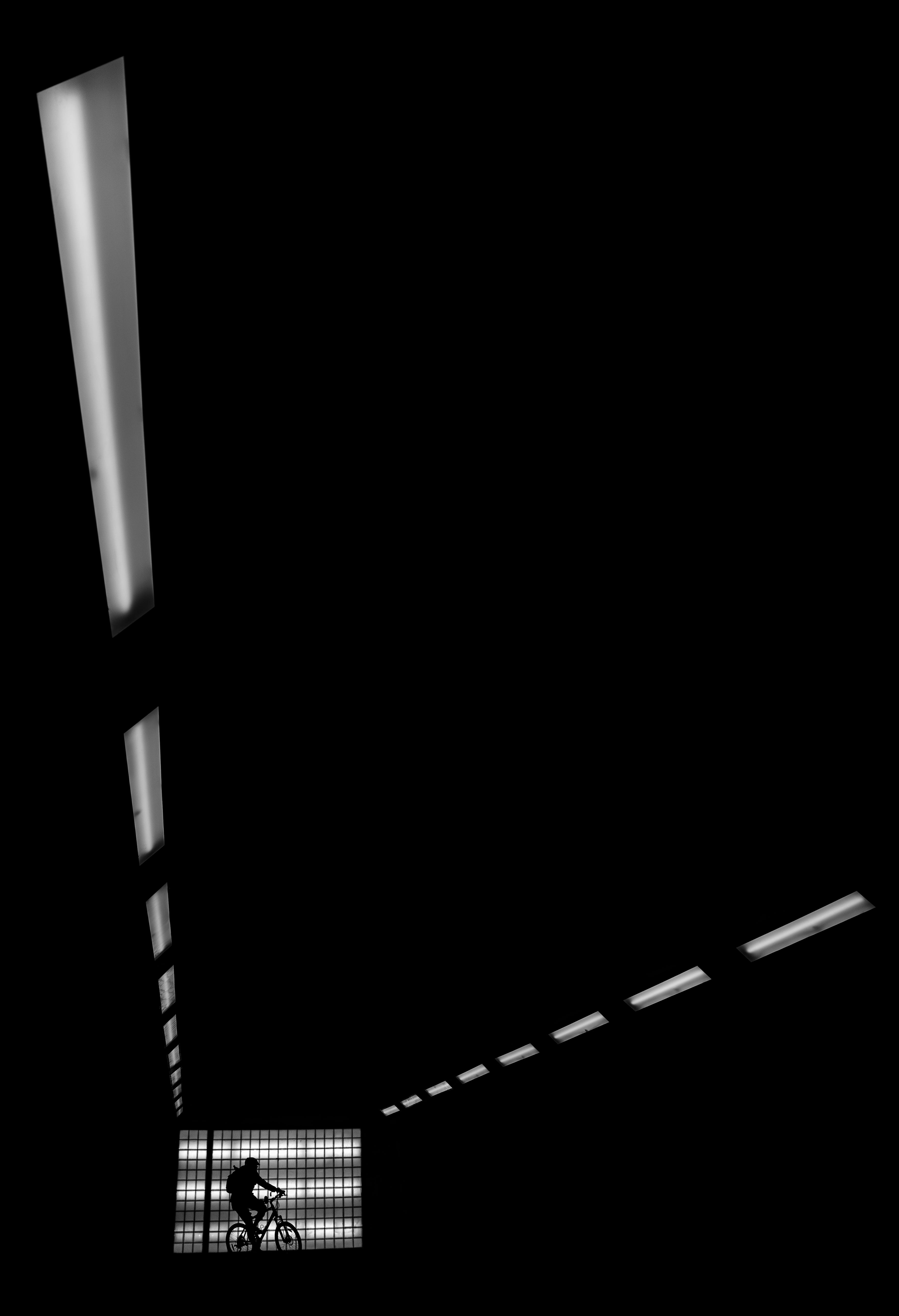
This photograph, taken at the railway station of Solothurn, Switzerland, captures a solitary cyclist silhouetted against a grid of illuminated panels, creating an interplay of light and shadow within an urban underpass.
The image is dominated by darkness, with the cyclist and the lighted panels occupying a small but impactful portion of the frame. This use of negative space heightens the sense of isolation and focus on the subject.
The ceiling lights form a diagonal line, drawing the viewer’s eye towards the cyclist and creating a sense of depth. This geometric precision adds to the minimalist composition.
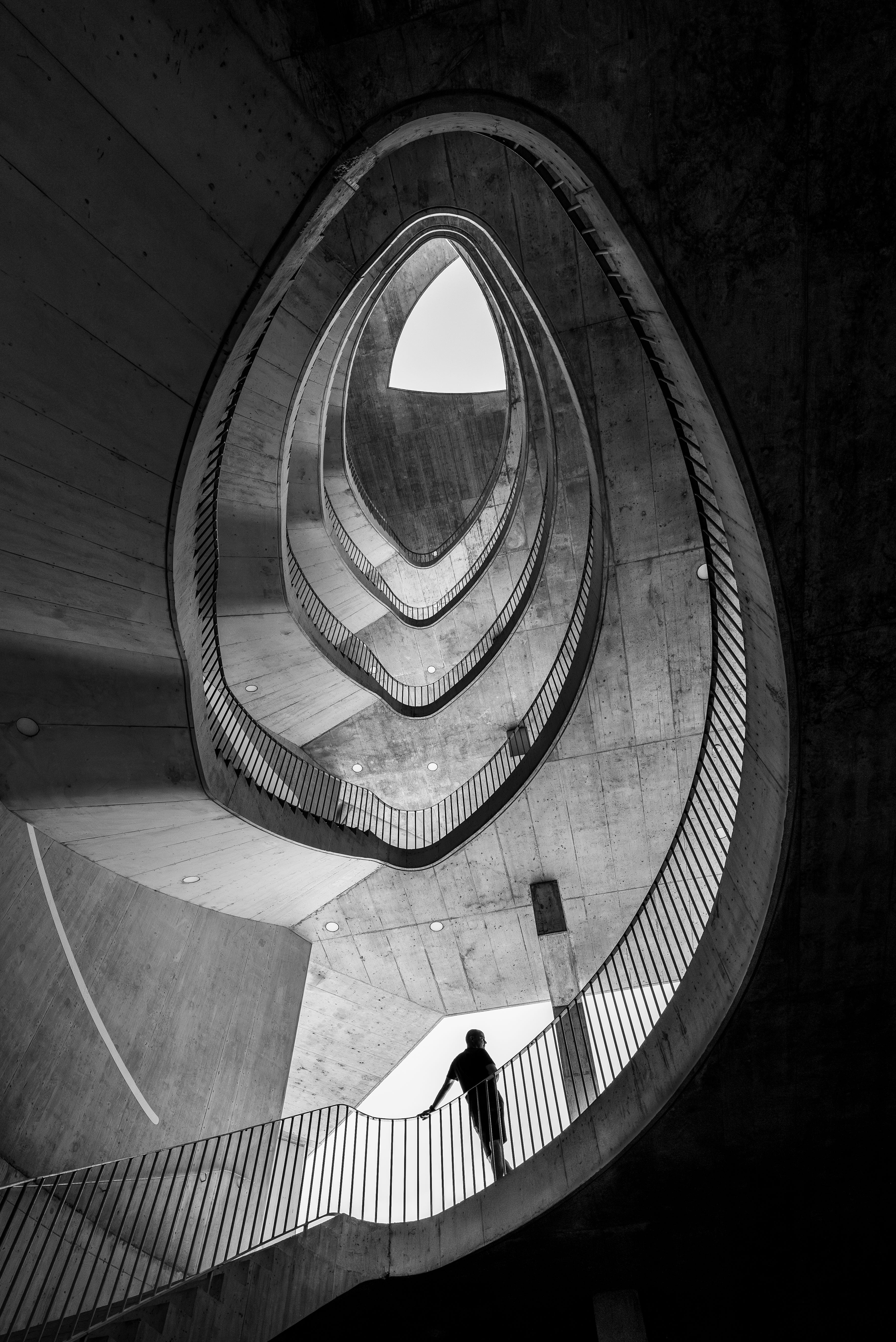
This photograph, taken at the Innovation Park in Allschwil, Switzerland, showcases the captivating architecture of the building’s interior, emphasizing its organic curves and geometric layers.
The frame is filled with repeating elliptical forms that spiral upward, leading the viewer’s gaze toward the open skylight. This repetition creates a dynamic rhythm within the image.
The solitary figure leaning on the railing provides scale and adds a human element, emphasizing the grandeur of the structure.
The bright opening at the top contrasts with the darker concrete walls, creating a sense of depth and highlighting the interplay between light and shadow.
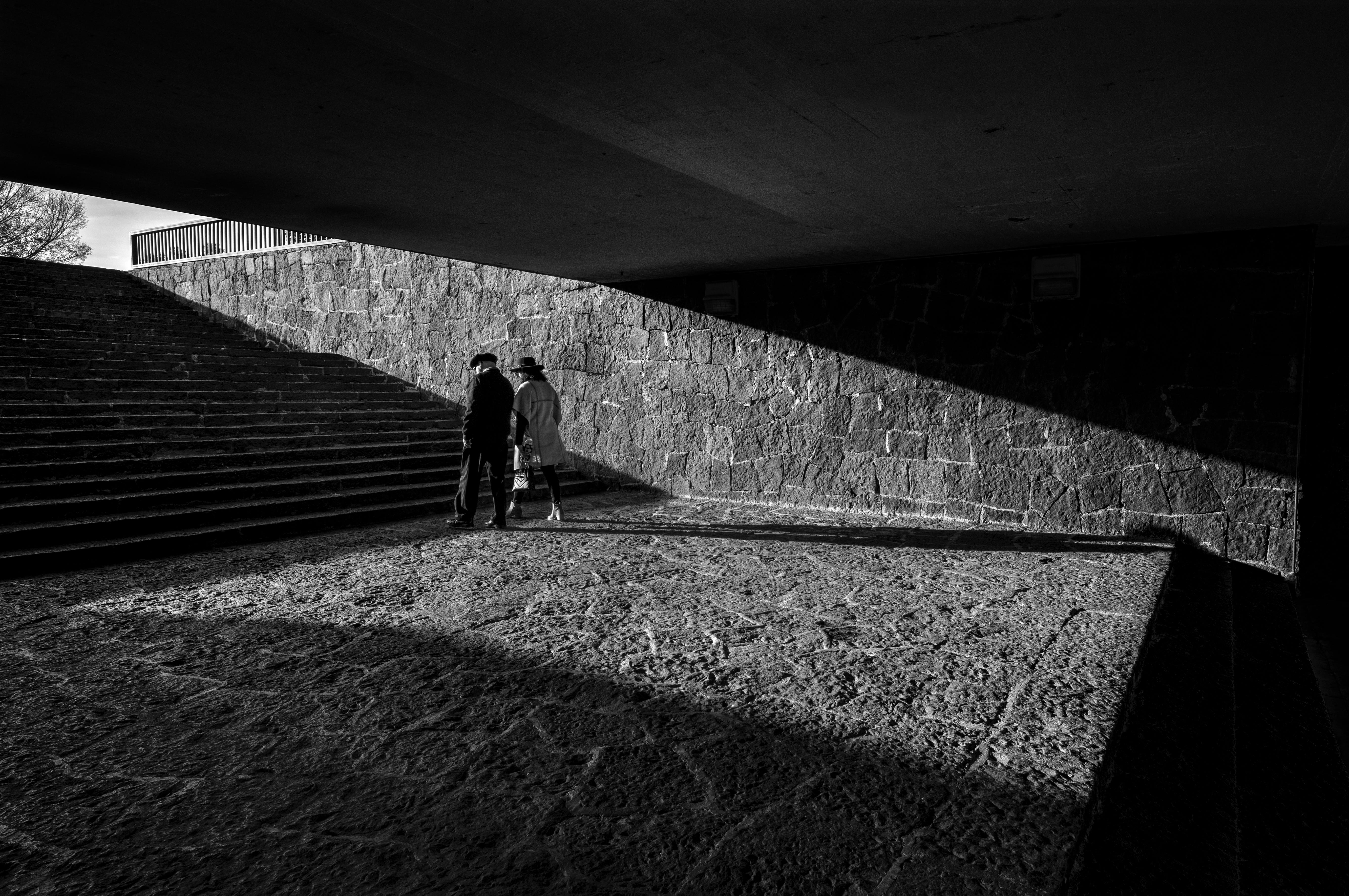
This photograph, taken at the National Autonomous University of Mexico (UNAM) in Mexico City, uses light and shadow to frame the two figures, creating an intimate yet dramatic composition.
The sharp, triangular shadow cast across the ground and wall effectively frames the two individuals, drawing the viewer's attention directly to them while isolating them within the vast space.
The interplay of light and shadow enhances the textures of the stone wall and floor, adding depth and a tactile quality to the image. Notably, the dark texture of the walls, derived from their volcanic lava origin, gives the scene an organic, rugged character that contrasts with the clean geometric lines.
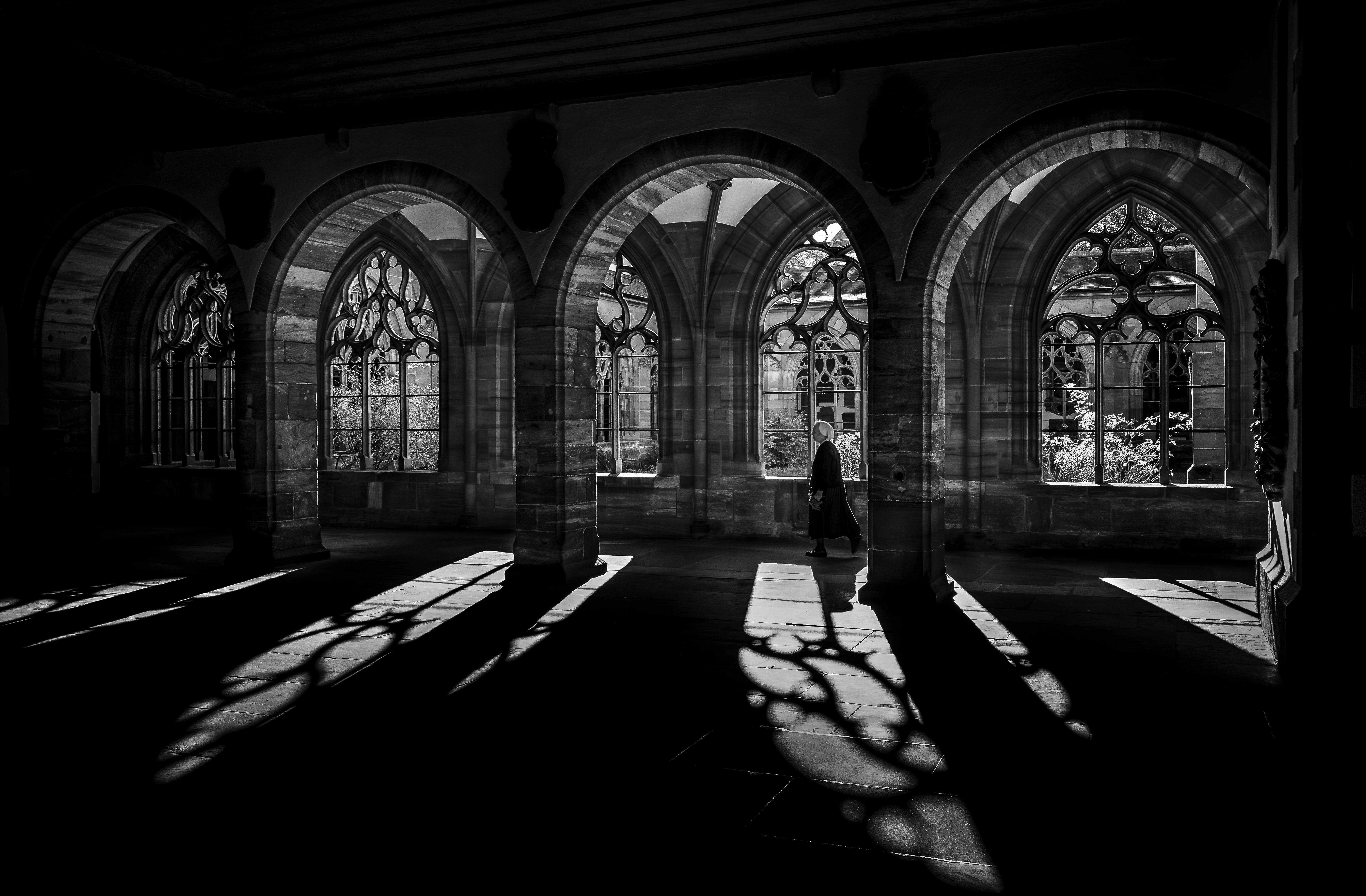
This photograph, taken at the Basler Münster in Basel, captures the interplay between architecture, light, and shadow, emphasizing the elegance and grandeur of the Gothic design.
The repetitive sequence of pointed arches frames the scene, drawing the viewer’s eye into the depth of the corridor. Each arch serves as a visual gateway, adding a rhythmic balance to the composition.
The light streaming through the intricate stained-glass windows casts ornate shadows on the floor, creating a dynamic interplay of light and dark that mirrors the curves of the architecture. This shadow play adds texture and a sense of movement to an otherwise still image.
The lone figure walking through the corridor, possibly a "Diakonin" dressed in black, adds a profound contrast to the scenario. The dark attire stands out against the illuminated patterns of light and shadow, enhancing the visual drama of the composition. The contemplative presence of the figure complements the solemnity of the space, evoking a mood of reflection and quiet reverence.
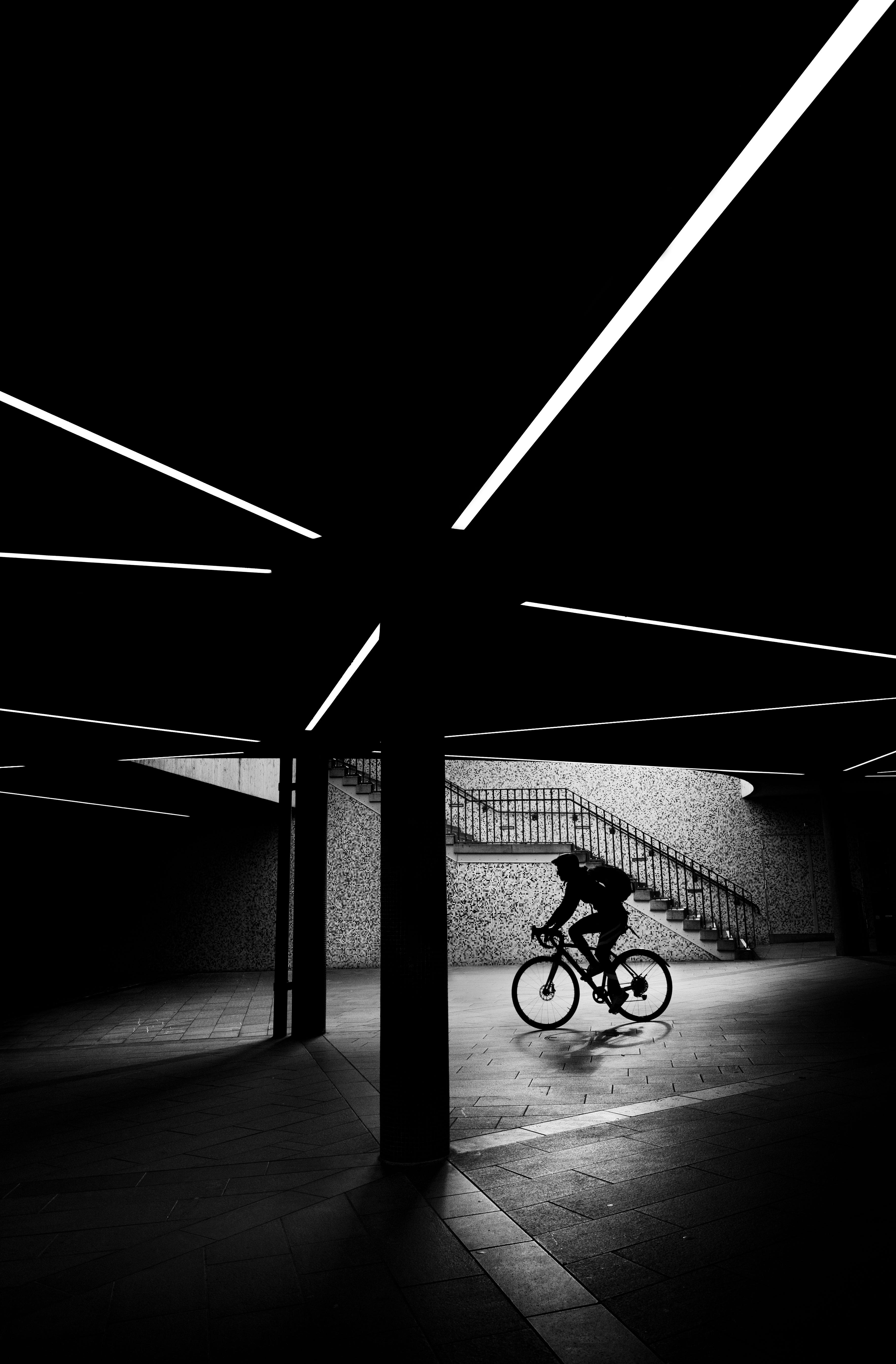
This photograph taken in Baden, Switzerland, presents an interplay of minimalistic architecture and human motion, dominated by the stark geometry of neon lights and contrasting shadows.
The crisscross pattern of neon lights on the ceiling draws immediate attention, creating a futuristic, almost surreal atmosphere. These lights serve as strong leading lines, guiding the viewer's eyes through the composition while enhancing the depth and structure of the space.
The bright neon illumination sharply contrasts with the deep shadows, isolating the cyclist in a minimalist and dramatic fashion. This interplay highlights the subject while maintaining the modern and abstract tone of the setting.
The cyclist adds a critical layer of narrative, introducing a moment of activity and spontaneity into an otherwise rigid and geometric space. The forward-leaning posture of the rider emphasizes motion and determination, complementing the modern aesthetic of the scene.
More about Enrique Pérez-Garci
That’s all for today, folks! I hope you enjoyed this peek into Enrique’s work.
If you’d like to be featured in a future article, feel free to drop me a message